In the place where I was born and raised, Aceh, there is this famous saying regarding the coming of Japan in early 1940s. I hope you excuse my words, it might sounds offensive but it simply reflected their desperate situation back then. In Aceh it goes like, “ta peutamong asee bah jih let bui,” which means, “let us invite the dogs so they could chase the pigs.”
When I mentioned Aceh, probably it reminds some of you about the prolonged colonial war. Islam was and is strongly embedded in the social cultural life of people in Aceh, thus their reactions and stereotype towards the Japanese and the Dutch.
As you might wonder or not, the dogs refer to the Japanese, while the pigs refer to the Dutch. In the teaching of Islam, both dogs and pigs are considered as “haram” or forbidden to touch and eat. But for the people in Aceh back then, the dogs seems to be more friendly and could help them to chase the pigs away.
I know this saying not from school, but from my father, who learn this from his father, my grandfather, whom I called ‘Yahnek Hamid’. I never have the chance to meet him, for he already passed away when my father was still in elementary school. During many gatherings of my extended family, I used to listen stories about Yahnek Hamid. One story about him that struck me was about his stay in Mecca during his early 20s. None of my aunty or uncle know how did he arrive there in such a young age. There were no cheap ticket flights as in today and it was quite expensive for people with low income to go and stay there. One of my uncle told me, Yahnek Hamid was involved in this organization Sarekat Islam in his village, Samalanga. He flee to Mecca to escape from the Dutch that chase him because of his activity in this organization.
Even after I learn about Sarekat Islam by reading books, I was still puzzled about this expalanation. I have never heard about Sarekat Islam in Aceh. And wasn’t that Sarekat Islam a legal organization back then? So why he had to escape to Mecca?
Two years ago, I was fortunate to receive a scholarship to pursue higher education in history in the University of Leiden. My plan two years ago was to do research about railway in Aceh made by the colonial government. But then, I revised this plan once I enter the Nationaal Archief in The Hague and surprisingly, I encounter several archives about my grandfather.
For research purpose, I have to read reports of political situation written by the Dutch officials in Aceh. In one of the reports within 1926 to 1929, I found a description about my grandfather, Syekh Abdul Hamid Samalanga, the son of Haji Idris, who was a teacher in Tanjongan, North Aceh. He flee to Mecca not because of his activity in Sarekat Islam, but in the Communist Party of Indonesia, or PKI. Within those year, a premature revolt occurred in Silungkang, West Sumatra, Banten and other parts of Java. To take down the communist, the colonial government chase and put them into exile in Boven Digul. According to the archives, my grandfather managed to escape by crossing the Malacca Strait and took a steamship until he arrived in Mecca. There, he drifted in the wave of Islamic reformism, introduced by Muhammad Abduh and Rasyid Ridha. Also according to the archives, he regularly sent letters to his fellow comrades in Samalanga and inform them about the Islamic reformism movement.
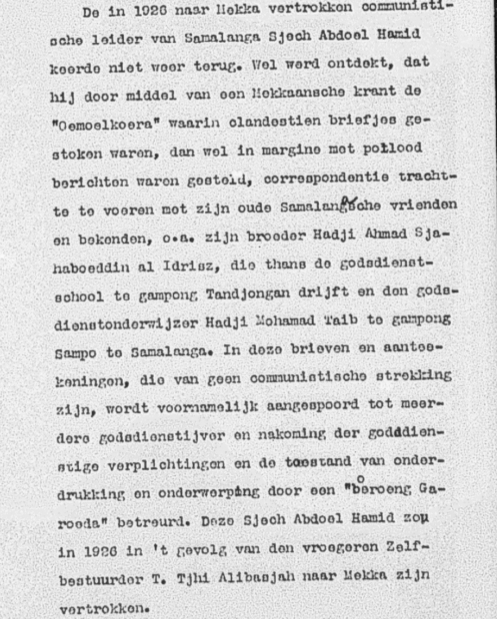
Dutch reports about correspondency between my grandfather and his friends in Samalanga through handwritten notes in the margin of newspaper “Ummul Qura”
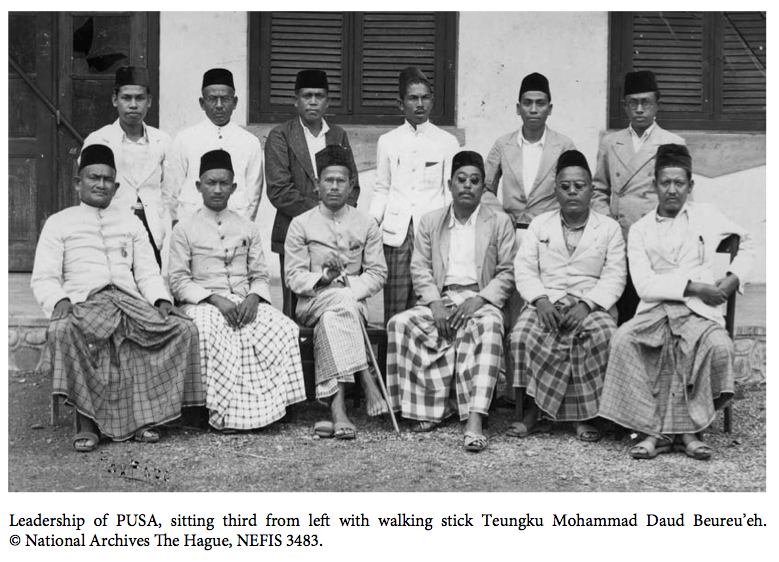
When the Pacific War broke in early 1940s, my grandfather was already back to Aceh. Along with his friends in the All Aceh Ulama Alliances or Pesatuan Ulama Seluaruh Aceh (PUSA), he welcomed the Japanese to chase the Dutch away. After the independence of Indonesia, he joined the Darul Islam Movement led by Daud Beureueh that demand Indonesia to be an Islamic State.
As adventerous as he may seems, he was no national or local hero. And it is pretty common in Aceh for people in his contemporary, to resist the legitimate government and go to war. But actually my point here is not about him, but about his wife, my grandmother, who I called Minek. During his life, my grandfather married four times and Minek was his latest wife. She might not know and understand what Yahnek Hamid did before and after they meet, but she accompanied him until his death in 1963. She was one among many others invisible woman within the history of Indonesia, that lives throughout the war and survived after it. Although she might not going through the whole war and resistance like my grandfather did, but she was the one who bear it alone, being a widow with nine children since nearly fifty years ago but somehow manage to educate her son, my father, to pursue his study until a doctoral degree and always encourage me, my sister and my female cousins to study, not to marry first.
Our lack of knowledge about women in history not only happens because people don’t write about it, but also because they were hidden in the archives. In her books, Reading East India Company, Betty Joseph trying to uncover the absence of women in the archives of East India Company by looking on the literatures written in those period and mention about the women. Although it’s a work of fiction, but it might the only way to understand about their presence in history. The works of Reggie Bay, and speeches of Ibu Farida Ishaja and Ibu Cisca Pattipilohy resonates the need to see the shared history of Netherlands, Japan and Indonesia from a different perspectives: the women, who struggled and went to the war, but neglected by the historian, or those women who might not go to war, but suffer it throughout their life and remain unidentified and forgotten until today.
I am very delighted to share this podium with the three of them. And I am more than happy to discuss about this more with any of you today. Thank you very much.
Speech delivered in “The Annual Dialoog Nederland Japan Indonesie Conference: Verhalen van Vrouwen vanuit Indonesisch Perspectief”, Bussum, NL, September 2017


 raisakamila.com
Leave a reply to Khalid Cancel reply